
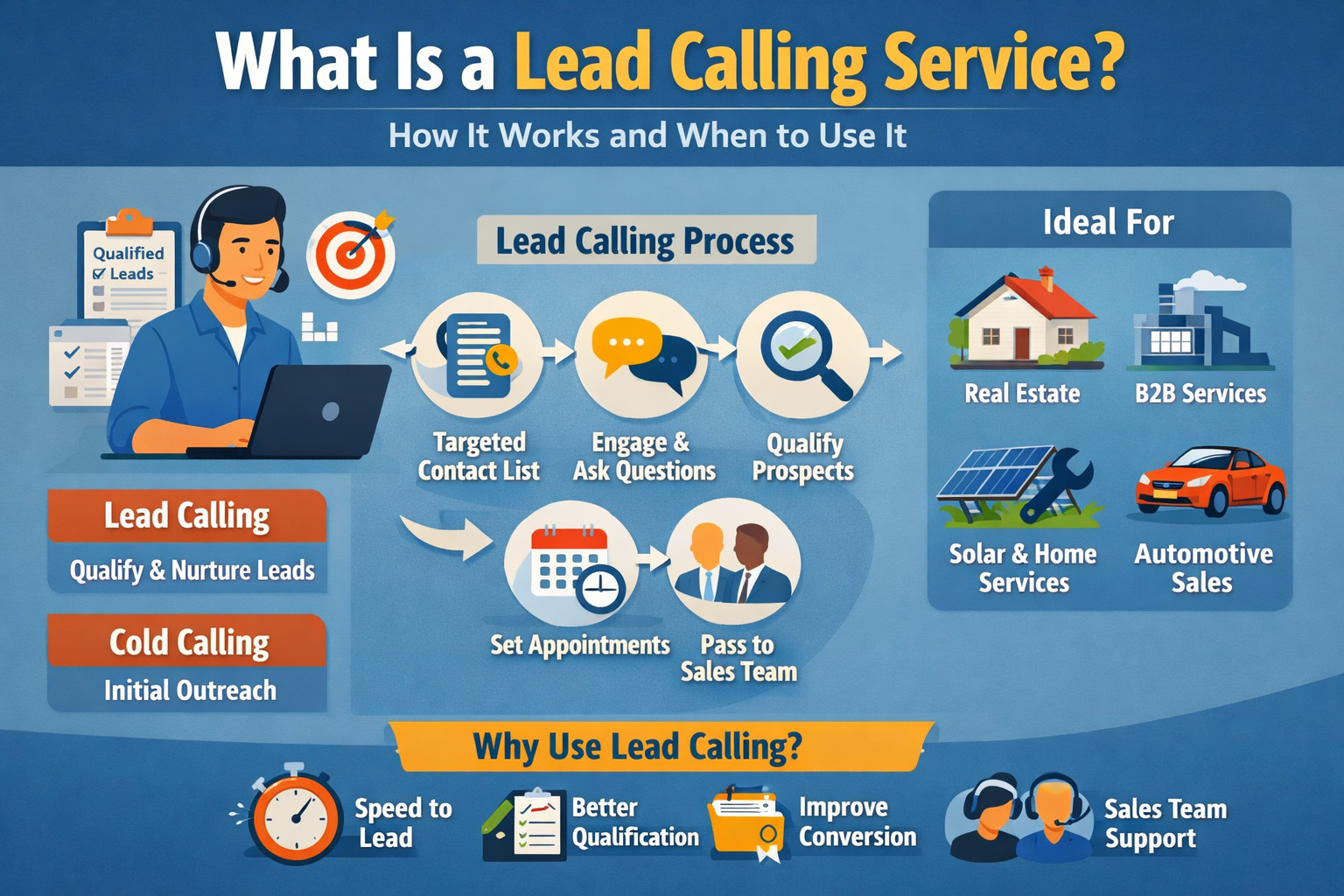
A lead calling service is a structured outbound approach where trained agents contact potential customers by phone to qualify interest, gather information, and move prospects closer to a sale.
Unlike basic telemarketing, a lead calling service focuses on conversations and qualification, not just pitching. The goal is to turn raw leads into real opportunities that sales teams can act on.
As businesses look for more predictable ways to generate pipeline, lead calling has become a core part of modern outreach strategies.
At its core, a lead calling process connects businesses with potential customers through direct phone conversations. These calls are not random — they are based on targeted lists, scripts, and defined goals.
A typical process includes:
The focus is not volume alone. A good lead calling service filters out unqualified prospects and delivers actionable leads.
These two terms are often used interchangeably, but they are not exactly the same.
In many cases, calling-based lead outreach are built on top of outbound cold calling strategies, especially when targeting new prospects.
A lead calling service is most effective when businesses need direct engagement instead of passive lead collection.
It is commonly used when:
For companies relying on conversations – not just clicks – calling remains one of the fastest ways to validate opportunities.
While many industries use calling, some rely on it more heavily due to the nature of their sales process.
Investors and agents use calling to reach homeowners, qualify motivation, and schedule appointments.
Companies selling services often require multiple touchpoints before closing deals.
High-ticket services benefit from direct conversations and appointment setting.
Lead calling helps qualify buyers and move them toward purchase decisions.
In these industries, combining calling with structured lead generation systems produces more consistent results.
Not all calling services deliver results. The difference is in execution and structure.
An effective lead calling service includes:
Without these elements, calls become noise. With them, calling becomes a predictable system.
Many businesses try lead calling and conclude it “doesn’t work.” In reality, the problem is usually execution.
Common mistakes include:
Lead calling only works when it is treated as part of a structured process, not a one-time experiment.
A lead calling service is not about making more calls — it is about making the right conversations happen at the right time.
When supported by strong data, trained agents, and clear processes, calling becomes one of the most direct and effective ways to move leads through the pipeline.
For businesses that depend on qualified opportunities rather than raw traffic, lead calling remains a key component of modern growth strategies