

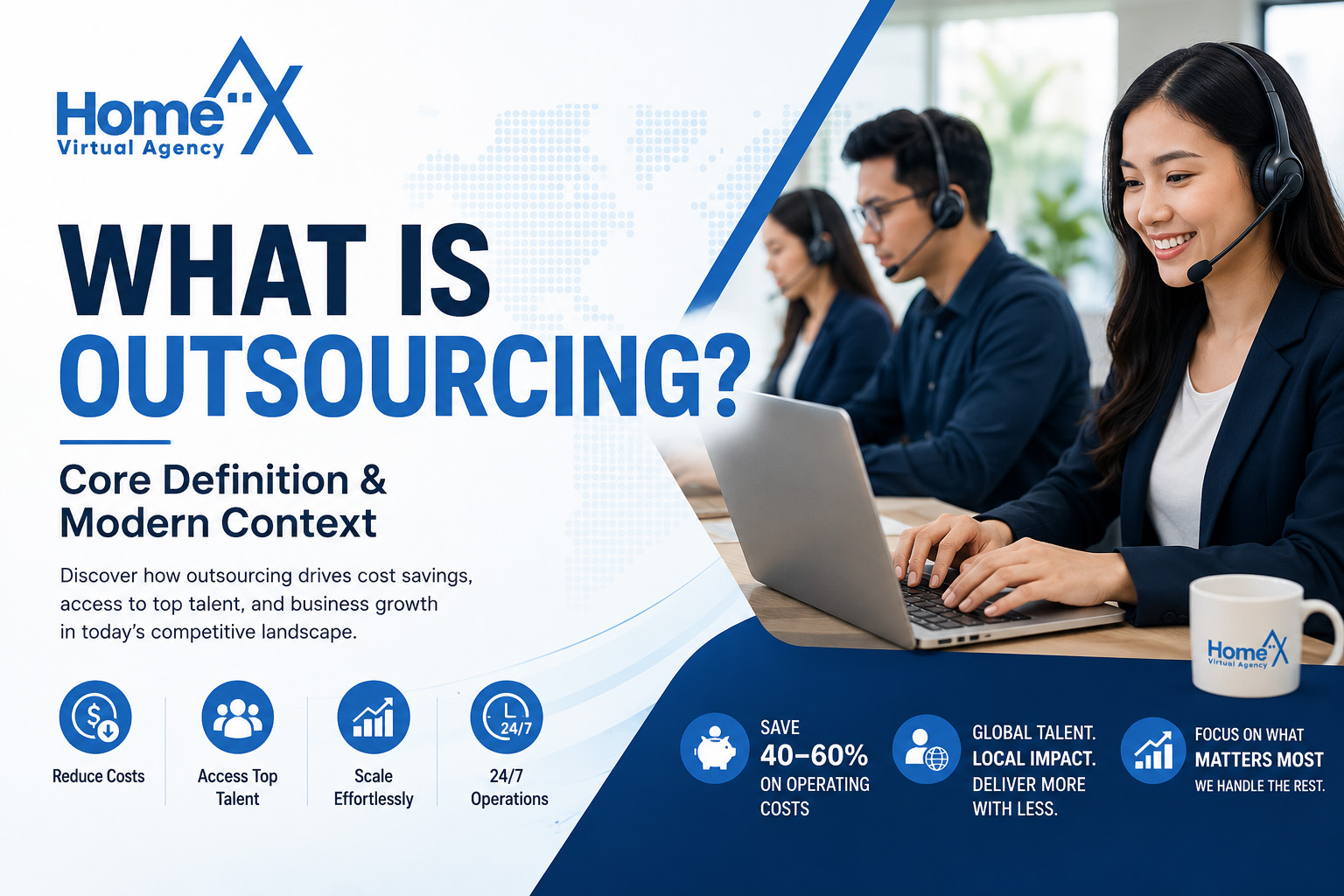
What Is Outsourcing? Core Definition & Modern Context
The benefits of outsourcing are most clearly understood when you treat it as a revenue strategy, not just a cost-cutting tactic. According to Investopedia’s definition of outsourcing, the practice involves contracting business functions to external parties — typically to reduce costs, access expertise, or increase operating speed. In 2025, that definition undersells reality.
Why Outsourcing Has Evolved Beyond Simple Cost-Cutting
A decade ago, outsourcing meant offshoring a call center to save on wages. Today, it means deploying a specialized remote team that runs a full sales pipeline, handles customer escalations at 2 a.m., or books appointments while your in-house team focuses on closing deals.
The shift is fundamental. Smart broker-owners and B2B operators no longer ask, “Can we afford to outsource?” They ask, “What does it cost us NOT to outsource?” The answer, when you run the numbers, is almost always uncomfortable.
How Outsourcing Fits Into 2025 Business Strategy
Remote work infrastructure matured rapidly after 2020. Today, a well-run outsourced team in a high-English-proficiency market can match — and often outperform — a domestic hire at 40–60% lower total cost. For US real estate teams operating on thin per-transaction margins, that delta is the difference between a profitable quarter and a breakeven one.
Top 8 Strategic Benefits of Outsourcing Your Business
1. Cost Reduction: Labor Arbitrage and Infrastructure Savings
This is the most immediate benefit — and the one most guides fail to quantify. Consider a mid-size real estate brokerage hiring a full-time inside sales agent (ISA) in the US:
- US ISA fully-loaded cost: $55,000–$75,000/year (salary + benefits + payroll tax + equipment)
- Outsourced equivalent: $18,000–$28,000/year (all-inclusive, no overhead)
- Annual savings per role: $27,000–$47,000
Scale that across three roles and you’ve freed up $80,000–$140,000 annually — capital you can reinvest in marketing, technology, or additional headcount.
2. Access to Global Talent Pools and Specialized Expertise
Outsourcing unlocks talent that doesn’t exist locally at your price point. Need a cold caller fluent in US real estate scripts, objection handling, and CRM workflows? That profile is rare and expensive in the US. In high-English-proficiency outsourcing hubs, it’s a standard hire.
3. Faster Time-to-Market and Accelerated Business Growth
Recruiting, onboarding, and ramping an in-house employee takes 60–90 days on average. An experienced outsourcing partner deploys a trained team in 1–3 weeks. For real estate teams entering a hot market or SaaS companies launching a new product, that speed advantage compounds quickly.
4. Improved Operational Focus on Core Competencies
Every hour a broker-owner spends managing a lead generation rep is an hour not spent on listings, negotiations, or investor relationships. Outsourcing transfers the management burden — not just the labor — to a vendor with the systems to handle it.
5. Scalability Without Fixed Overhead or Hiring Delays
Outsourced teams scale on-demand. Add two cold callers for Q1 campaign season. Drop back to one in Q3. No severance, no WARN Act notices, no HR paperwork. This flexibility is especially valuable for real estate businesses where lead volume is seasonal and unpredictable.
6. Lower Risk Through Vendor Redundancy and Compliance
A quality outsourcing vendor manages employment law compliance, data security protocols, and agent redundancy. If one agent leaves, the vendor backfills — not you. That shifts operational risk from your P&L to the vendor’s SLA.
7. 24/7 Operations and Timezone Coverage
US real estate prospects call back at 7 p.m. on a Tuesday. SaaS customers submit support tickets at midnight. An outsourced team built across timezones covers those windows without expensive shift differentials or overtime pay.
8. Technology Access Without Capital Investment
Enterprise-grade dialers, CRM integrations, call recording, quality assurance software — these tools cost $500–$2,000/month when purchased independently. Most professional outsourcing vendors include them in the service fee, eliminating your capital outlay entirely.
Want to see which RE lead generation channels work best for your market
Outsourcing ROI Calculator: Real-World Examples
Case Study: Real Estate Agency Outsourcing Cold Calling
A 12-agent brokerage in the Southeast replaced one in-house ISA ($68,000/year fully-loaded) with an outsourced cold calling team of two agents ($26,000/year combined). Results after 90 days:
- Call volume increased from 80 to 220 dials per day
- Qualified appointments booked per week rose from 4 to 11
- Cost per appointment dropped from $326 to $91
- Annual savings: $42,000 — enough to fund a second marketing channel
This mirrors broader industry data on back office outsourcing for real estate, where 40–60% overhead reductions are consistently achievable when functions are properly scoped.
Case Study: B2B SaaS Company Outsourcing Customer Support
A Series A SaaS company outsourced tier-1 support (password resets, billing questions, basic troubleshooting) to a remote team. Their in-house agents shifted entirely to tier-2 and customer success. Within six months:
- Average first-response time dropped from 6.2 hours to 47 minutes
- NPS score improved by 18 points
- Support cost per ticket dropped 44%
- In-house team churn dropped — they were doing more meaningful work
How to Calculate Your Outsourcing ROI Before Committing
Use this simple framework before signing any contract:
- Current fully-loaded cost: salary + benefits + payroll tax + management time + tools
- Outsourced cost: all-inclusive monthly fee × 12
- Gross savings: Current cost − Outsourced cost
- Transition costs: onboarding hours, integration setup, quality assurance ramp (typically 2–4 weeks)
- Net Year-1 ROI: Gross savings − Transition costs
For most real estate and B2B operators, Year-1 net ROI lands between 150% and 300%. Year 2 and beyond runs clean — transition costs disappear entirely.
Industries & Functions That Benefit Most From Outsourcing
Sales and Lead Generation
Cold calling, appointment setting, and lead qualification are high-volume, process-driven functions. They don’t require in-house presence — they require discipline, scripts, and a great dialer. Outsourcing these functions to a specialized team delivers more dials, more consistency, and better data capture than most in-house hires.
Explore how real estate cold calling services unlock off-market opportunities that in-house teams consistently miss due to volume constraints.
Customer Support and Helpdesk Operations
Tier-1 support is ideal for outsourcing. It’s high-volume, repetitive, and script-friendly. Keeping it in-house burns your best people on low-complexity tickets. Outsource it, free your senior staff, and watch satisfaction scores climb.
Back-Office Functions
Data entry, transaction coordination, HR administration, and accounting are functions where errors cost money but expertise doesn’t need to sit in your office. Outsourcing back-office work to dedicated remote specialists cuts error rates and processing time simultaneously.
Content and Digital Marketing Services
SEO content, email sequences, social media management, and paid ad management are specialized skills with clear output metrics. Outsourcing to vetted specialists with vertical experience (real estate, SaaS, finance) beats hiring a generalist in-house at twice the cost.
Outsourcing Strategy: When & How to Outsource by Business Stage
Pre-Product to Seed Stage: Outsource Non-Core, High-Time Functions First
At this stage, your constraint is founder time, not capital efficiency. Outsource administrative tasks, calendar management, data research, and basic customer communications. These functions consume 15–20 hours per week for most early-stage operators — hours that should go to product and sales.
A virtual assistant for real estate investors is a practical first outsourcing step: low cost, fast ramp, immediate time recovery.
Growth Stage (Post-Revenue, Pre-Scale): Scale Customer Support and Operations
Once you have consistent revenue, customer support volume grows faster than you expect. Outsource tier-1 support before it breaks your in-house team. Simultaneously, begin outsourcing inbound lead qualification to keep your sales pipeline moving without adding fixed headcount.
Scale Stage: Add Strategic Functions Like Sales and Lead Gen
At this stage, you have proven unit economics. Now outsource outbound sales and lead generation at volume. A dedicated outsourced sales team running 300–500 dials per day generates pipeline at a cost per qualified lead that no in-house team can match at equivalent spend.
Warm Leads, Clear Scripts, Steady Projects
How to Choose an Outsourcing Vendor: Evaluation Framework
Define Your KPIs and Service-Level Agreements (SLAs) First
Before you evaluate any vendor, define what “good” looks like. For cold calling: dials per day, connect rate, appointments set per week, cost per appointment. For support: first-response time, resolution rate, CSAT score. Vendors who can’t commit to specific SLAs are not operationally mature enough to trust with your customers.
Vet Vendor Experience, Certifications, and Case Studies
Ask for vertical-specific case studies, not generic testimonials. A vendor who has run campaigns for real estate investors understands skip tracing logic, motivated seller psychology, and CRM workflows that a general BPO vendor simply doesn’t. Certifications matter for data security (SOC 2, ISO 27001) — especially if the vendor handles customer PII.
Run a Paid Trial Period Before Full Commitment
Require a 30-day paid trial with defined success metrics before signing a long-term contract. Any credible vendor will accept this. Use the trial to evaluate communication quality, reporting cadence, QA processes, and actual output against promised SLAs. A 30-day trial costs less than one bad 12-month contract.
Common Outsourcing Risks & How to Mitigate Them
Quality Control and Communication Challenges
Risk: output quality drifts without consistent oversight. Mitigation: require weekly KPI reporting, monthly QA call reviews, and a dedicated account manager. Set a response-time SLA for Slack or email communication — 2 business hours is reasonable and tells you immediately whether the vendor is organized.
Data Security and Compliance Concerns
Risk: customer data exposure, TCPA violations in cold calling, GDPR/CCPA gaps. Mitigation: require a signed Data Processing Agreement (DPA), confirm TCPA-compliant dialing practices, and verify that agents access data only through permission-controlled systems — never downloadable spreadsheets sent via email.
Cultural Fit and Brand Alignment
Risk: outsourced agents sound robotic, use wrong terminology, or damage brand experience. Mitigation: invest in a proper onboarding playbook — scripts, brand voice guidelines, objection handling frameworks, escalation protocols. Vendors who resist providing recorded samples before hire are a red flag.
Dependency Risk and Vendor Management
Risk: over-reliance on a single vendor creates fragility. Mitigation: after 90 days, document all SOPs internally. Run quarterly vendor reviews. For high-volume functions, qualify a backup vendor even if you never use them — the optionality alone improves your negotiating position and operational resilience.
Outsourcing Benefits in Real Estate & B2B: Special Cases
Why Real Estate Teams Outsource Cold Calling and Lead Generation
Real estate cold calling is a volume game. A motivated seller who is 6 months from listing needs to hear from you before your competitor does. In-house agents average 60–80 dials per day. A dedicated outsourced cold calling team averages 200–300 dials per day per agent — with consistent script adherence and real-time CRM updates. The math on pipeline generation is not close.
The secondary benefit is agent morale. Your licensed agents didn’t get into real estate to cold-call FSBOs and expired listings for six hours a day. Let them do what they’re licensed and motivated to do: present, negotiate, and close.
How B2B SaaS Companies Benefit From Outsourced Customer Success
In SaaS, churn is existential. A 1% monthly churn rate on a $500K MRR book destroys $60,000 per year in recurring revenue. Outsourced customer success agents — properly trained on your product and escalation workflows — handle onboarding check-ins, usage coaching, and renewal prep at a fraction of in-house cost. The ROI isn’t just cost savings; it’s revenue retention at scale.
Looking to outsource support or scale quickly?
HomeX builds elite call center teams from Kosovo, Albania, and North Macedonia — ready to grow with you
The businesses winning in 2025 aren’t the ones with the most in-house headcount. They’re the ones that know exactly which functions to keep internal and which to outsource to specialists who execute at higher volume, lower cost, and measurable quality. The benefits of outsourcing are real, quantifiable, and compounding — but only when you build the right strategy from the start.